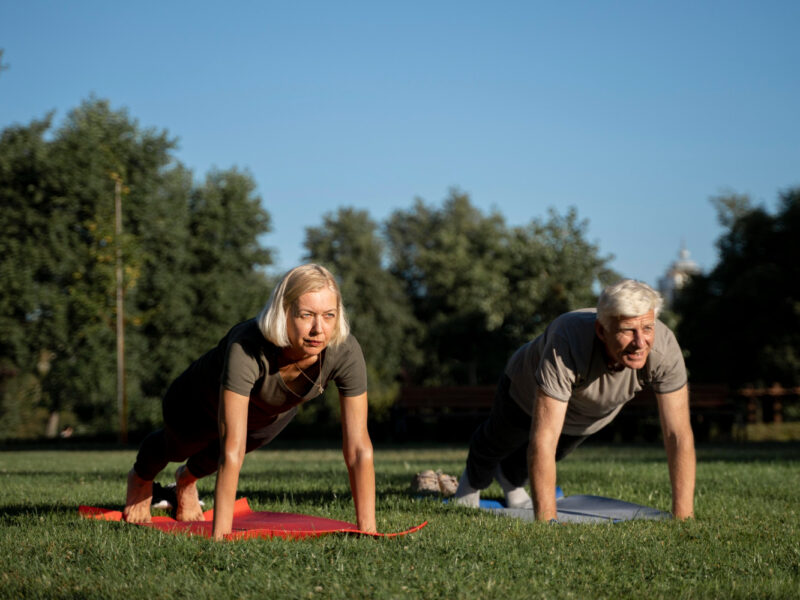


The gym is a convenient excuse – because if you don’t have time for the commute, it’s easy to say training isn’t possible. Meanwhile, living rooms, bedrooms, and balconies across the country are turned into workout spaces every day, with no membership and no queues for equipment. A home workout plan doesn’t require expensive gear or years of experience. Here’s how to start and keep going past the first week!
Key facts about home training:
- Home training can be just as effective as the gym when exercises are chosen properly
- Two to three sessions a week of 30-45 minutes are enough to see real changes in strength and fitness
- Bodyweight exercises engage multiple muscle groups simultaneously and reduce the risk of injury
- Consistency matters more than intensity – three short weekly sessions deliver better results than one long one
- Progression without a barbell is achievable by changing tempo, range of motion, and exercise variations
Does home training deliver the same results as the gym?
Home training delivers comparable results in terms of strength, endurance, and body composition – provided the intensity and progression are appropriate. Research published in the Journal of Strength and Conditioning Research found that people training with their own bodyweight achieved similar gains in muscular strength to those using machines, across a similar training period.
The difference emerges with advanced goals. Building substantial muscle mass after several years of training requires external loads that bodyweight alone can’t provide. For most people – particularly beginners and those exercising for health – home training is sufficient for years. Bodyweight exercises improve strength, balance, and bone density as effectively as loaded training in people over 50.
Where should you begin with home training?
What equipment do you need to get started?
To start, you don’t need any equipment at all – your own body is enough for the first 3-6 months. Squats, push-ups, lunges, and planks engage all major muscle groups. If you’d like more variety, two items will do: resistance bands (which cost around £10-15) and a training mat. That’s an investment for years, not just a month.
Useful equipment for home training:
- A training mat – protects the knees and spine during floor exercises
- Resistance bands – replace dumbbells for many exercises and take up less space than a wallet
- A pull-up bar (door-mounted) – the only piece of equipment that opens an entirely new category of exercises
- A chair or box – for step-ups, elevated exercises, and Bulgarian split squats
How often should you train to see results?
Three sessions a week of 30-45 minutes are enough to see progress in strength and fitness within the first 4-6 weeks. Rest days between sessions allow muscles to recover, which is essential for building strength. More isn’t always better – four sessions a week is the maximum for beginners; beyond that, the risk of overtraining rises.
A weekly training plan for beginners
The plan below assumes three training days and four rest or light activity days. Each session lasts 30-40 minutes including a warm-up. It’s built on three pillars: upper body strength, leg and hip strength, and core stability. Rotating these elements allows frequent training without loading the same muscles on consecutive days.
| Day | Focus | Example exercises | Sets x reps |
| Monday | Upper body + core | Push-ups, plank, banded rows, superman | 3 x 8-12 |
| Wednesday | Legs + hips | Squats, Bulgarian split squats, single-leg deadlift, glute bridge | 3 x 10-15 |
| Friday | Full body | Burpees, mountain climbers, squat jumps, side plank | 3 x 8-12 |
Even a simple home workout plan built around these three days is enough for the first few months. Active recovery supports muscle repair and improves mobility, which naturally declines with age.
Which strength exercises can be done without equipment?
Squats, push-ups, lunges, planks, and glute bridges are five exercises that together engage all major muscle groups. Each has easier and harder variations, allowing progression without added weight. Knee push-ups for beginners, standard push-ups at the next stage, clap push-ups for the advanced – the same foundation at three levels of difficulty.
Sarcopenia – the gradual loss of muscle mass with age – affects everyone from the age of 30. Regular strength exercises, even with bodyweight alone, effectively slow this process. The key is progression: when an exercise becomes too easy, switch to a harder variation rather than adding more repetitions.
Bodyweight exercises for every muscle group:
- Legs – squats, Bulgarian split squats, step-ups, pistol squats
- Chest and arms – push-ups (wide, narrow, diamond), pike push-ups
- Back – pull-ups, inverted rows using a table, superman
- Abs and core – plank, side plank, dead bug, hollow body hold
- Glutes and hips – glute bridge, donkey kicks, leg abduction
How can you add cardio to a home workout?
Home cardio doesn’t require a treadmill or a stationary bike. Jumping jacks, burpees, mountain climbers, and fast skipping on the spot raise the heart rate just as effectively as jogging. The key difference between HIIT and steady-state training lies in intensity – both have a proven impact on heart health and endurance.
The most effective strategy combines 2-3 strength sessions a week with 1-2 cardio sessions. Interval training – for example, 30 seconds of effort followed by 30 seconds of rest for 15-20 minutes – delivers comparable cardiovascular benefits to 40 minutes of steady-pace running. For those just starting, even a 10-minute HIIT session three times a week is enough.
The most common mistakes in home training
Skipping the warm-up is the number one mistake. At home, it’s tempting to skip the first five minutes and jump straight into exercises, which increases the risk of injury. The warm-up needn’t be long – arm circles, unweighted squats, hip rotations, and gentle bends are enough. Five minutes prepares joints and muscles for the load ahead.
Mistakes that slow progress in home training:
- No plan – “I’ll do a bit of something” ends in chaotic training with no progression
- Too fast a tempo – slow, controlled repetitions build strength more effectively than quick movements
- Skipping the warm-up – even five minutes halves the risk of injury
- No progression – the same exercises at the same sets after three months is stagnation
- Training through pain – muscular discomfort is normal; sharp joint pain is a signal to stop
How can you increase training intensity at home?
Progression without extra weight relies on four strategies: increasing range of motion, changing tempo (slower reps), switching to single-leg or single-arm variations, and shortening rest periods between sets. A bilateral squat too easy? Move to a Bulgarian split squat. Standard push-up no longer challenging? Add a three-second lowering phase.
Research from Applied Physiology, Nutrition, and Metabolism confirms that training with a slow eccentric tempo – that is, slowly lowering the body during the negative phase – increases strength by 20-30% more than fast repetitions. It’s the simplest progression method at home, as it requires no equipment at all. The minimum effective dose of movement is lower than most people think, but it must grow over time.
Consistency matters more than intensity
People who train three times a week for a full year achieve better results than those who train six times a week for three months and then quit. Consistency beats intensity every time. In longevity populations – in Okinawa, Sardinia, and Ikaria – it isn’t intense exercise but daily moderate activity that is the common thread among people reaching 90 and 100. Home training makes consistency easier by removing the commute, queues, and class schedules.
FAQ: Frequently asked questions about home training
How many minutes of training a day is enough?
Thirty minutes of moderate training 3-4 times a week is sufficient to improve strength, fitness, and body composition for most beginners and intermediate exercisers.
Is home training good for weight loss?
Home training supports fat loss, particularly when combined with a caloric deficit, though exercise alone isn’t enough without changes to diet.
Is home training safe for older adults?
Bodyweight exercises are safer than machine-based training because they require natural movement patterns and allow full control of range of motion – it’s worth starting with easier variations and gradually increasing difficulty.
References:
- Suchomel, T. J., et al. (2018). The importance of muscular strength: Training considerations. Sports Medicine. https://doi.org/10.1007/s40279-018-0862-z
- Schoenfeld, B. J., et al. (2017). Hypertrophic effects of concentric vs. eccentric muscle actions: A systematic review and meta-analysis. Journal of Strength and Conditioning Research. https://doi.org/10.1519/JSC.0000000000001983
- Ashton, R. E., et al. (2020). Effects of short-term, medium-term and long-term resistance exercise training on cardiometabolic health outcomes in adults. PLoS ONE. https://doi.org/10.1371/journal.pone.0210483