
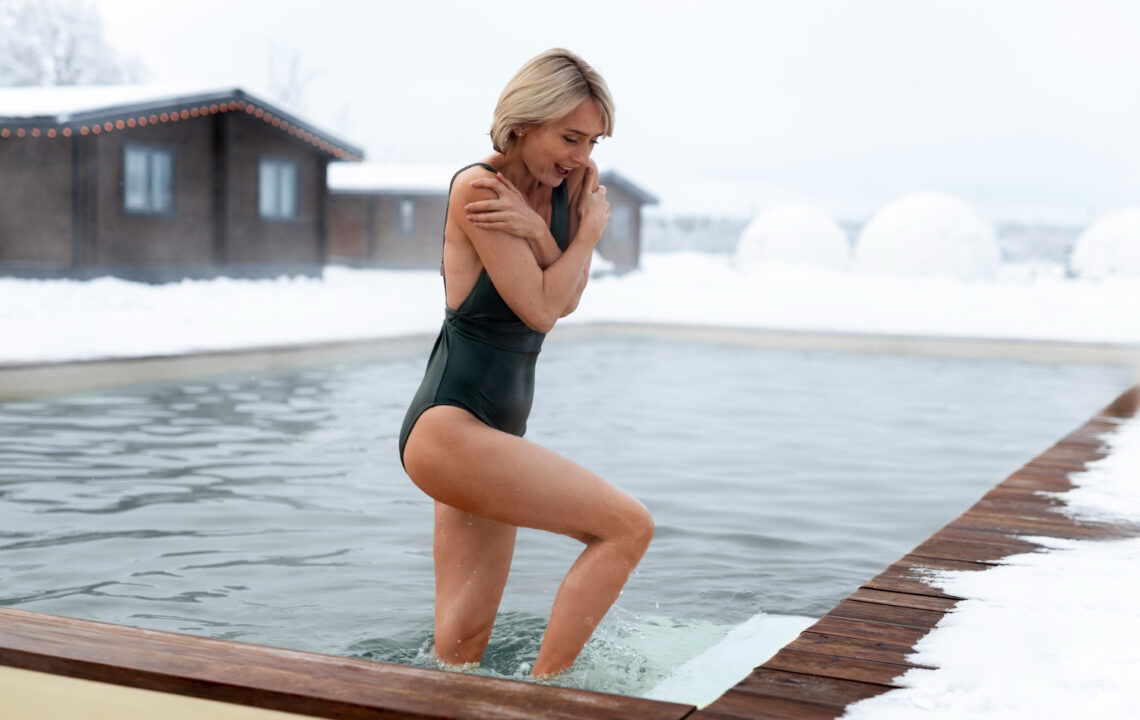
On a dark January morning by the Baltic Sea, the first figures in woolly hats and plastic sandals appear at the shore. After two minutes in water at three degrees Celsius they come out warm and visibly calmer. It’s a short, controlled stressor the body responds to with precision. Cold water immersion offers measurable benefits for the nervous system, metabolism and immunity, but only when used sensibly. Find out what we know today about cold exposure from a longevity point of view.
Key facts about cold exposure:
- Short cold exposure activates brown adipose tissue, which burns energy to produce heat
- Noradrenaline levels after immersion can rise 2-3 fold and stay elevated for hours
- A regular cold shower (30-90 seconds) is linked to fewer sick days
- Cold hormesis works in reasonable doses; longer and colder isn’t better
- Contraindications include heart disease, hypertension and arrhythmias
What is cold water immersion and how does cold hormesis work?
Cold water immersion means submerging the body in water close to freezing, usually 0-5 degrees Celsius, for tens of seconds up to a few minutes. In physiological terms it’s a controlled winter bath in which the body receives a strong but brief stress signal.
The mechanism is called hormesis: a small dose of a stressor strengthens the body while a large dose harms it. Strength training, fasting and interval exercise follow the same rule. Examples of when stress is actually good for you show the key is dose and recovery. Cold in sensible amounts lowers inflammation and improves tolerance to other stressors.
What happens in the body during cold water immersion?
In the first seconds peripheral vessels constrict, blood is pushed towards internal organs, and heart rate and blood pressure rise sharply. This is the cold shock response. Then the sympathetic nervous system takes over, adrenaline and noradrenaline spike, and the body produces heat from its reserves. There’s also a brief rise in oxidative stress, which activates genes for cellular repair.
How does cold activate brown adipose tissue?
Brown adipose tissue (BAT) is a type of fat that, instead of storing energy, burns it in mitochondria to produce heat. Work by the van Marken Lichtenbelt team at Maastricht University showed that regular cold exposure markedly increases BAT activity and improves insulin sensitivity in adults. It’s one of the mechanisms by which cold supports glucose metabolism.
How do noradrenaline and testosterone change?
An hour in water at 14 degrees Celsius can raise noradrenaline up to fivefold; in near-freezing water the rise is faster and shorter. Noradrenaline drives alertness, focus and mood. In men there’s also a modest rise in testosterone, weaker than after resistance training. Does cold exposure work at the hormonal level? It does, but the outcome depends on consistency and session length.
Does cold water immersion reduce stress and improve mental health?
Cold water triggers a paradoxical response: strong arousal first, then deep calm and a clear lift in mood. The cause is a release of endorphins, endocannabinoids and dopamine after getting out of the water. The same mechanism explains why people dealing with chronic stress describe cold exposure as a mental reset. Consistency is critical: a series of sessions over several weeks builds real resilience.
How quickly does stress drop after a cold bath?
Subjective stress drops noticeably within 30 minutes of leaving cold water, and the effect lasts several hours. The diving reflex kicks in, slowing the heart and stimulating the vagus nerve, the main pathway of the parasympathetic system. How long does a cold plunge need to be? Two to three minutes in water at a few degrees are enough.
Does a cold shower reduce the number of sick days?
A Dutch trial by Buijze and colleagues at the University of Amsterdam (PLOS ONE 2016) enrolled 3018 participants who ended their morning shower with 30, 60 or 90 seconds of cold water for 30 days. Those using cold endings had 29% fewer days of sickness absence than the control group. The length of exposure didn’t change the result; what counted was adding cold at all. Full immersion can produce similar effects faster, but a shower is the easiest entry point.
How many seconds of cold shower are enough?
The minimum effective dose is 30 seconds a day. The protocol below can be followed through the whole year, even without access to a lake.
A simple 30-day cold shower protocol:
- Week 1: a normal shower finished with 30 seconds of lukewarm and then cool water
- Week 2: 30 seconds of clearly cold water, slow breathing
- Week 3: 60 seconds of cold water, directing it first at the legs, then the torso
- Week 4: 90 seconds of cold water, natural diaphragmatic breathing
Is cold water immersion safe for everyone?
For a healthy adult cold water immersion is generally safe, provided entry is gradual and no records are chased. Risk rises with hidden heart problems, uncontrolled blood pressure or arrhythmia. The first minutes in icy water are the biggest cardiovascular load of the session.
Who should NOT do cold water immersion?
Contraindications to cold water immersion:
- Ischaemic heart disease and a history of heart attack without cardiologist clearance
- Untreated high blood pressure and serious arrhythmias
- Pregnancy, especially complicated or in the later stages
- Acute infections with fever and flaring inflammatory conditions
- Epilepsy, Raynaud’s disease and uncontrolled hyperthyroidism
Cold water immersion vs cold shower – what to choose at the start?
A cold shower is safe, repeatable and available all year. Full immersion gives a stronger physiological signal, but requires supervision and a good level of fitness. For anyone with no prior exposure the natural first step is the shower, then an ice bath at home, and only then open water. The health benefits of cold water immersion show up when we stick to the rules: never alone, never after alcohol, never after a sleepless night.
Other schools of thermotherapy show that cold is only one pole. The Japanese tradition of bathing in hot springs and the European culture of alpine water treatments combine heat and cold in one ritual. Alternating temperatures train the blood vessels and the nervous system.
How to start safely?
A reasonable start is one month of cold showers, then an ice bath at home or a dip in a lake with an experienced companion. Cold water triggers adaptations that usually require weeks of training. People with heart disease or high blood pressure should talk to their doctor before starting.
FAQ: Common questions about cold water immersion
Is cold water immersion healthy?
For healthy adults it supports mood, immunity and metabolism, as long as it’s used in moderation and cardiovascular contraindications are ruled out.
How do I start cold water immersion from scratch?
Start with 30 seconds of cold water at the end of your shower for a month, and only then try a short open-water dip with an experienced group.
How many minutes of cold water immersion are enough?
Two to three minutes in water at a few degrees – a longer stay raises the risk of hypothermia without proportional benefit.
Who should avoid cold water immersion?
People with ischaemic heart disease, uncontrolled hypertension, serious arrhythmias, epilepsy, during pregnancy, and during acute infections.
References:
- Buijze, G. A., Sierevelt, I. N., van der Heijden, B. C., Dijkgraaf, M. G., & Frings-Dresen, M. H. (2016). The Effect of Cold Showering on Health and Work: A Randomized Controlled Trial. PLOS ONE. https://doi.org/10.1371/journal.pone.0161749
- van Marken Lichtenbelt, W. D., & Schrauwen, P. (2011). Implications of nonshivering thermogenesis for energy balance regulation in humans. American Journal of Physiology. https://doi.org/10.1152/ajpregu.00652.2010
- Kelly, J. S., & Bird, E. (2022). Improved mood following a single immersion in cold water. Lifestyle Medicine. https://doi.org/10.1002/lim2.53