

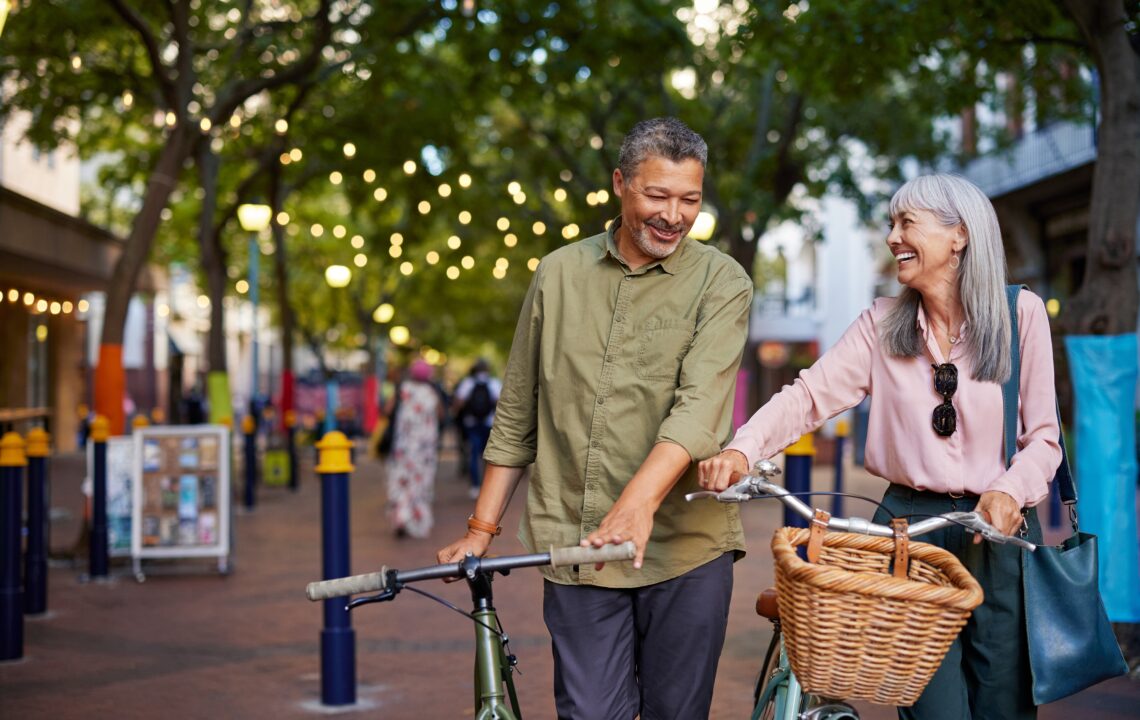
When we think about longevity, we usually think about diet, exercise and physical activity. However, something that we often treat as background plays a huge role: the city and neighbourhood where we live every day. Whether you breathe polluted air every day, have somewhere to walk, or feel safe, has a real impact on your life expectancy and quality of life.
The World Health Organisation emphasises that cities – despite the challenges – can create ‘better health, a cleaner environment and comfort’ if urban policies explicitly prioritise health. It is already clear that where we live is increasingly becoming a health decision rather than just a logistical one.
‘Health is created where we live’ – cities as living environments
In the famous Ottawa Charter of 1986, the WHO reminded us: ‘Health is both created and experienced by people in their daily lives; where they learn, work, play and love.’ The city is therefore not just a backdrop – it is an active ‘co-creator’ of our health.
In practice, this means that:
- the streets we walk (or do not walk) on,
- parks and green spaces (or lack thereof),
- air quality,
- noise, lighting, safety,
- opportunities to meet other people
– all contribute to the daily ‘programme’ for our bodies. Over a period of 10, 20 or 30 years, the differences between a longevity-friendly city and a longevity-unfriendly city can mean a real difference in the number of years lived in good health.
Hard facts: cities can shorten or lengthen life
A few figures illustrate the scale of the problem:
- According to global analyses, current levels of air pollution reduce global life expectancy by approximately 1 year and 8 months. In some regions, especially those with high levels of pollution, this effect can be as much as 5 years of lost life expectancy.
- The WHO estimates that lack of physical activity, often linked to unfavourable city policies and lack of access to recreational areas, accounts for approximately 3.3% of all deaths worldwide.
- Systematic studies show that access to green spaces is associated with lower mortality and better cardiovascular health.
- Large cohort studies indicate that people living in walkable neighbourhoods have a lower risk of death from obesity-related and cardiovascular diseases.
Added to this is new data on the link between air quality and the brain. A review of more than 50 studies involving 29 million people found that long-term exposure to PM2.5 fine particulate matter and other pollutants is associated with an increased risk of dementia.
In short, a city can act as a health supplement – or as a slow-acting toxin.
Features of a longevity-friendly city
Danish urban planner Jan Gehl has been saying for years that we need to ‘build cities for people’ rather than for cars – cities that ‘move’ at the pace of a pedestrian, around 5 km/h. If we look at longevity, it’s easy to see what he means.
A longevity-friendly city is one that:
- Facilitates walking and daily movement
- Pavements, pedestrian crossings, calmed traffic, cycle paths, short distances between home, shops, schools and services. In such an environment, physical activity ‘happens by itself’ – on the way to work, school or shopping.
- Has plenty of green space
- Parks, squares, trees along streets, waterfront boulevards. Studies consistently show that contact with greenery is associated with lower mortality, lower stress levels and better mental health.
- It breathes cleaner air
- Restricting car traffic in city centres, low-emission zones, good public transport, the development of cycling and walking – all these factors contribute to lower concentrations of particulate matter, which today shortens life as seriously as smoking.
- It creates spaces for meetings and relationships
- Squares, cafés, community centres, sports fields, neighbourhood clubs. Loneliness is increasingly referred to as the ‘new disease of civilisation’, and a well-designed city facilitates spontaneous meetings and the building of support networks.
- It is safe and predictable
- Street lighting, the presence of people, well-designed crossings, lower traffic speeds. A sense of safety encourages people to leave their homes, take evening walks and enjoy the city after work.
- It provides easy access to health services and education
- Clinics, counselling centres, health workshops, senior activation programmes – the closer and more ‘on the way’ they are, the greater the chance that we will actually use them.
Such a city works for our longevity 24/7 – even when we are not thinking about it.
How to assess your neighbourhood in terms of longevity?
Instead of just looking at square footage and commute to work, it’s worth asking yourself a few questions in the spirit of a longevity lifestyle:
- Can I do most of my daily errands on foot in 15 minutes (shop, pharmacy, basic services)?
- Is there a park, square or green space within a 10-15 minute walk that I can really use?
- How often do I decide not to leave the house because I am afraid of traffic, smog or noise?
- What does my typical day look like – does the city encourage me to be active, or does it rather ‘lock’ me in my car and office?
- Do I see places in the neighbourhood where people naturally meet – squares, benches, cafés, clubs?
The answers do not necessarily lead to moving house. However, they can form the basis of a plan for the coming years: what can I change within the scope of my influence?
What if you live in a place that is not conducive to longevity?
Not everyone can move to an ideal, green neighbourhood overnight. However, this does not mean that you are doomed to a worse life. You can:
- Consciously choose your routes – instead of the main, busy street, choose parallel, quieter streets, neighbourhood shortcuts, alleys between blocks of flats. Sometimes the difference in air quality and noise between two routes is enormous.
- Introduce greenery into your immediate surroundings – plants in your home, a communal garden, a balcony full of greenery. It won’t replace a park, but it will create a regenerative ‘micro-sanctuary’.
- Take advantage of the best parts of the city – weekends in parks, by the water, in neighbourhoods that promote activity. The city is a whole, not just your street.
- Take care of the air quality in your home – if possible, use an air purifier, ventilate during off-peak hours, and have plants that support indoor air quality.
- Join local initiatives – neighbourhood councils, public consultations, tree planting campaigns. Often, a small group of residents can fight for a speed bump, a new crossing, greenery or a playground.
Thinking in terms of longevity does not have to mean perfection – it is about consistently moving in a better direction.
Choosing a city as a strategic decision for a longevity lifestyle
If you are planning to move – to a different city, country or neighbourhood – it is worth treating it as a strategic decision for longevity. In addition to price, standard of living and distance from work, add the following to your checklist:
- air quality in the area,
- amount of greenery and recreational areas,
- availability of public transport,
- noise level,
- sense of security,
- presence of a community you want to belong to.
At the global level, the WHO is now encouraging cities to enter a ‘new era of urban health action’, pointing out that combining urban policies with health concerns is the key to resilient, prosperous societies. At the individual level, this means something simpler: consciously choosing places that promote a long and full life, not just a comfortable one in the here and now.
A longevity-friendly city does not have to be perfect. It just needs to provide you with more opportunities for exercise, relationships, contact with nature and cleaner air, day after day. The rest – diet, exercise, sleep – starts to fall into place more easily when your environment is working with you.
Key Takeaways
- The city and neighbourhood have a key impact on the length and quality of life, not just diet and physical activity.
- The World Health Organisation emphasises that urban policy should prioritise health.
- Features of a longevity-friendly city include access to green spaces, clean air, and spaces that encourage social interaction.
- Not everyone can move to an ideal neighbourhood, but you can improve your quality of life locally through small changes.
- Choosing where to live should be a strategic decision for longevity, not just convenience.