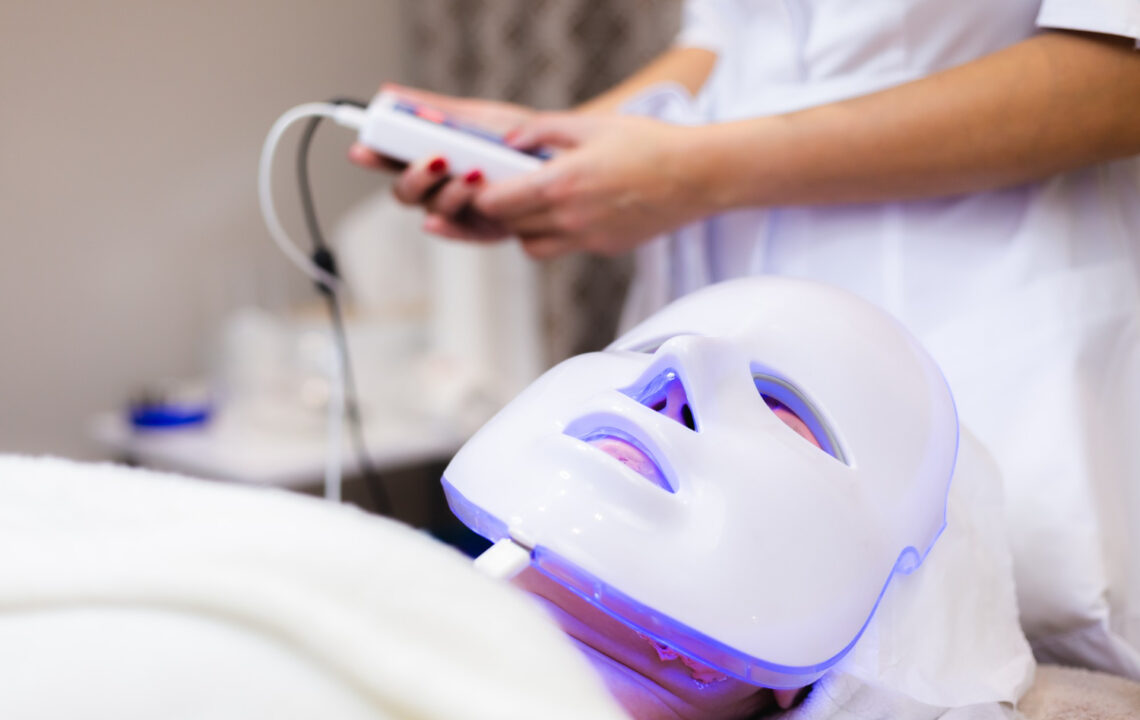
Panels glowing red behind shielded eyes, LED face masks on celebrities, athletes lighting up their knees between workouts. Red light therapy has moved out of dermatology offices and into bedrooms, gyms and longevity clinics. The question is whether solid evidence sits behind the trend, or simply marketing dressed in colour. We’ve gathered what studies say about red light treatment and separated uses backed by strong data from the experimental ones. See where red light therapy works.
Key facts about red light therapy:
- The strongest evidence covers skin, muscle recovery and hair loss
- Wavelengths of 630-850 nm penetrate tissue at different depths
- Weaker evidence appears in studies on the brain and gut
- Mitochondria are the main target for red light photons
- Home panels range from a few hundred to several thousand pounds
What is red light therapy?
Red light therapy is a controlled exposure of the skin to light with a wavelength of 630-850 nanometres, emitted by LED diodes or low-power lasers. The procedure is also known as photobiomodulation or LLLT. Unlike UV radiation, red light doesn’t damage DNA and doesn’t cause burns.
The therapy has a 60-year research history – back in the 1960s, surgeon Endre Mester noticed that a ruby laser accelerated wound healing in mice. The mechanism works at cellular level: photons are absorbed by cytochrome c oxidase, an enzyme in the mitochondria, which increases ATP production. Mitochondria take part in the 9 hallmarks of ageing – hence the interest from longevity medicine.
Which wavelengths are most effective?
The most effective wavelengths in clinical trials are 630-670 nm (visible red) and 810-850 nm (near-infrared, NIR). The first works on the surface of the skin, the second reaches deeper, into muscles and joints. The choice of wavelength depends on the therapeutic goal and the depth of tissue the photons need to reach.
Wavelength ranges and their uses:
|
Wavelength |
Colour |
Penetration depth |
Typical use |
|
630-660 nm |
Visible red |
3-5 mm |
Skin, fine lines, wounds |
|
670 nm |
Deep red |
5-8 mm |
Collagen, retina |
|
810-830 nm |
Near-infrared |
30-40 mm |
Muscles, joints, brain (experimental) |
|
840-850 nm |
NIR |
40-50 mm |
Deep tissue, recovery |
Good panels usually combine two wavelengths, most often 660 nm and 850 nm. Devices emitting one band are narrower in scope. In everyday cellular recovery, both wavelengths have their place.
Does red light therapy really improve the skin?
Yes, it does – and this is the area where scientific evidence is strongest. A meta-analysis in Photomedicine and Laser Surgery (13 studies, over 600 patients) showed significant improvement in skin smoothness and elasticity after LED therapy. The best results were recorded after 8-12 weeks of treatment twice a week. The mechanism is biochemical: light stimulates fibroblasts, the cells that produce collagen.
Skin effects confirmed in research:
- Reduction of wrinkles around the eyes and mouth after a course of sessions
- Increased collagen production of types I and III
- Improved texture and skin tone
- Faster healing of minor irritations
- Less redness and smaller pore visibility
Red light supports repair of photoageing, the skin damage caused by years of sun exposure. RLT doesn’t replace sunscreen, however – treatment works regeneratively, but if you keep burning your skin, the result will be zero. The therapy fits healthy ageing as a complement to diet, sleep and movement.
What else does red light therapy help with?
Besides the skin, red light therapy has a documented effect on muscle recovery after exercise and on the treatment of androgenetic hair loss. These are the three main areas where evidence is consistent and reproducible between different research teams. Beyond that, the list of uses keeps growing, but the quality of data drops.
In sport, exposure before or after training shortens recovery time and reduces muscle fatigue. In dermatology, RLT is also used for acne, keloids and hard-to-heal wounds. Individual studies suggest help with seasonal mood disorders, but the data here is weaker.
Does it reduce muscle soreness?
Yes, it does – especially the delayed onset muscle soreness after intense exercise, known as DOMS. Randomised trials show that illuminating muscles before training delays the moment of fatigue, and light after training accelerates the return of strength. The effect is moderate, but reproducible across more than a dozen clinical trials.
How a DOMS protocol looks:
- Light exposure before training for 5-10 minutes at a distance of 15-30 cm
- A second session after training within 30 minutes of finishing the workout
- A focus on the muscle groups most loaded on a given day
- Repeating the protocol throughout a training microcycle
Alongside muscles, the therapy is also studied in the context of androgenetic hair loss. A systematic review from 2021 indicated a significant increase in hair density after 16-26 weeks of using laser caps or panels. Note: effects disappear after stopping light exposure.
How reliable is the evidence for red light therapy?
Whether red light therapy works depends on the indication – current red light therapy research delivers very mixed evidence, from solid meta-analyses to individual studies on small groups. How the therapy works at the cellular level, we understand well. Worse is the answer to how strongly it works in a specific condition. The main weaknesses are small samples, different protocols and a lack of standardisation.
Part of the mechanism comes from the effect on oxidative stress and the balance of free radicals. Red light can modulate levels of reactive oxygen species – at therapeutic doses beneficially, at excessive doses harmfully. This is a classic hormetic relationship, known from other physical therapies.
What does red light therapy have the strongest evidence for?
The strongest evidence covers three areas: skin rejuvenation, muscle recovery after exercise and the treatment of androgenetic hair loss. In these three indications there are meta-analyses covering dozens of clinical trials, and the results are consistent between teams.
Areas with different strengths of evidence:
- Strong evidence: skin photoageing, muscle recovery, hair loss
- Moderate evidence: acne, wound healing, joint inflammation
- Weak or experimental evidence: neurodegenerative diseases, gut health, hormones, mood
Pilot studies have also emerged on RLT in Alzheimer’s and Parkinson’s disease. Trials include between a dozen and several dozen people, and a placebo effect is hard to rule out. It’s a promising research direction, not a proven therapy for now.
How to use red light therapy at home?
Three parameters are crucial: wavelength, beam power and session regularity. A panel used three times a week delivers more than an expensive device that sits unused. Repeatability matters more than intensity.
It’s worth checking whether the panel has verified power output. Manufacturers sometimes publish marketing values that don’t match radiometer readings. Reputable brands release reports from independent laboratories.
Which panel to choose?
Choose a panel with two wavelengths (660 nm and 850 nm), a power output of at least 100 mW/cm² from 15 cm and a treatment area matched to your needs. A smaller panel is enough for the face and neck, a larger one treats the back or thighs. Diode quality is the key factor.
Panel evaluation criteria:
- Wavelengths confirmed by a radiometer, not only by marketing
- Power density of at least 100 mW/cm² at 15 cm
- EMF and flicker kept at low levels
- Medical certificates or at least independent tests
- Service and warranty available in Europe
How long and how often to use it?
A standard session lasts 10-20 minutes, performed 3-5 times a week. A longer exposure doesn’t produce better effects, and in some studies it even weakens them – this is a hormetic relationship, known from other physiological stimuli as well. Better to go shorter and regular than an hour once a month.
Red light therapy effects appear gradually – skin ones usually after 4-6 weeks, recovery after several sessions, hair after 4-6 months. It’s worth planning at least a three-month trial before deciding whether the therapy works for you. Sounds like a lot, but count it up: about 36-50 sessions of a quarter of an hour, meaning a dozen or so hours over three months.
How much does home therapy cost?
What red light therapy costs at home depends on panel size and component quality. Small face masks start at 100-200 pounds, medium panels range from 400 to 1000 pounds, and large full-body devices cost 1500-4000 pounds. A clinic session is 40-80 pounds.
A home panel pays off after 20-40 sessions. For a single trial, a few clinic sessions are a better starting point.
Who shouldn’t use red light therapy?
Red light therapy isn’t suitable for people taking photosensitising medication, with active skin cancers, severe eye diseases, in pregnancy or with photosensitive epilepsy. Watch the retina – looking directly into intense LED can damage it, protective goggles are standard. Effectiveness isn’t identical for everyone – it depends on mitochondrial genetics and health status. Consult a doctor if in doubt.
This article is educational and does not constitute medical advice. Before starting regular red light therapy, especially with coexisting skin or eye conditions or when taking photosensitising medication, consult a doctor.
FAQ: Frequently asked questions about red light therapy
Does red light therapy really work?
It works in three documented areas: skin rejuvenation, muscle recovery and hair loss, while other uses still have weak or experimental evidence.
How much does a red light therapy lamp cost?
Prices range from about 100 pounds for small face masks to several thousand pounds for large full-body panels, while a specialist clinic session costs 40-80 pounds.
How long to treat the face with red light?
An optimal session lasts 10-15 minutes, repeated 3-5 times a week for at least 8-12 weeks, with a distance of about 15-30 cm from the panel.
Is red light therapy safe?
When used correctly, the therapy is considered safe, but people taking photosensitising medication, pregnant women and patients with eye diseases should consult a doctor before use.
References:
- Wunsch, A., Matuschka, K. (2014). A controlled trial to determine the efficacy of red and near-infrared light treatment in patient satisfaction, reduction of fine lines, wrinkles, skin roughness, and intradermal collagen density increase. Photomedicine and Laser Surgery. https://doi.org/10.1089/pho.2013.3616
- Ferraresi, C., Huang, Y. Y., Hamblin, M. R. (2016). Photobiomodulation in human muscle tissue: an advantage in sports performance? Journal of Biophotonics. https://doi.org/10.1002/jbio.201600176