
For two decades, Brazilian cardiologist Claudio Gil Araujo ran a clinic for people over forty in Rio de Janeiro. He noticed that patients who could not hold a one-leg stance for ten seconds tended to disappear from his consulting room earlier than others. The link between one-leg balance and mortality turned out to be more precise than many laboratory tests. See why ten seconds says so much about the state of the body.
Key facts about the one-leg balance test:
- The 10-second test predicts the risk of death within 7 years more accurately than chronological age.
- Failing the test is linked with an 84% higher risk of death during the observation period.
- Balance engages three systems – vision, the inner ear and proprioceptors (sensors in the muscles and joints that tell the brain where the body is).
- Between 51 and 55, about 5% of people fail the test; past the age of 71, more than half do.
- 3-5 minutes of practice a day improves balance within eight weeks of consistent training.
What does the one-leg balance test involve?
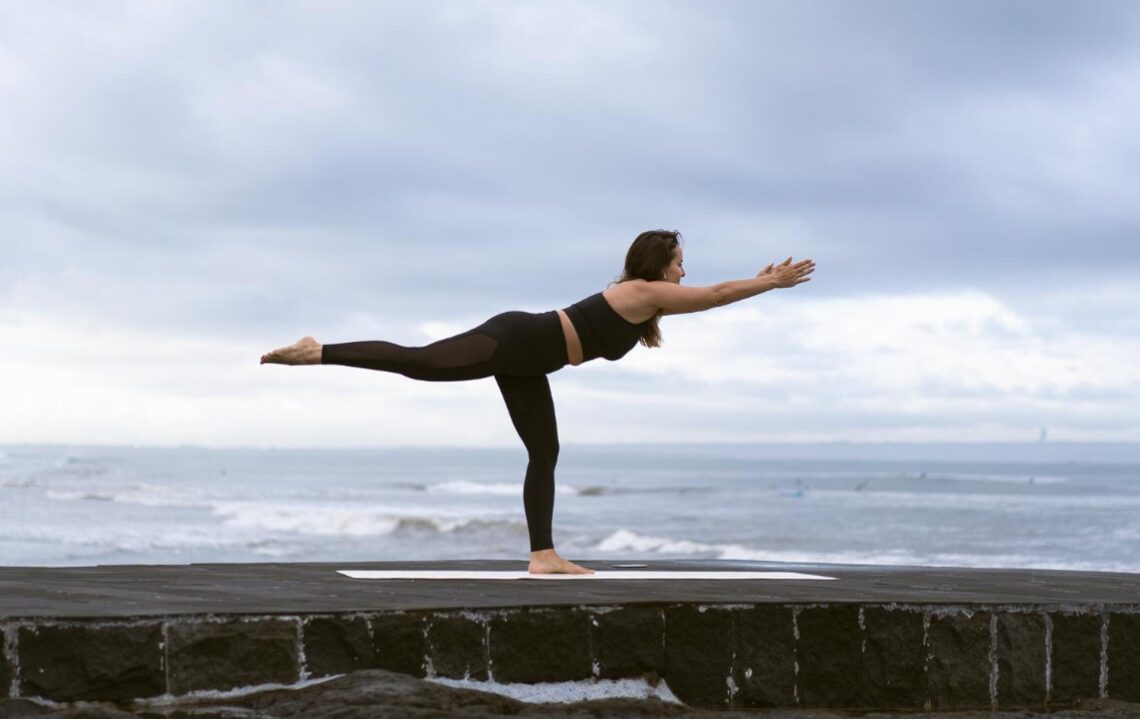
The test involves holding your balance on one leg for 10 seconds with eyes open, without any support and without swinging the arms. One foot rests on a hard floor, the other hovers above it. It sounds trivial, yet after fifty it proves difficult for many. Araujo allowed three attempts on each leg. This is the simplest version of the one-leg stance age test used in cardiology clinics.
How to perform the 10-second test correctly?
Stand upright, barefoot, on a firm surface. Lift one foot so that the top of the foot rests behind the calf of the supporting leg. Let the arms hang and look straight ahead. Start the stopwatch and hold the position for ten seconds. If you grab a wall, shift the supporting foot or put the lifted leg down, the attempt is invalid. You have three attempts per side.
How many people fail the test and what does it mean?
Research by Dr. Claudio Araujo’s team in the British Journal of Sports Medicine showed that of 1,702 people aged 51 to 75, as many as 20.5% failed the test. Over seven years of follow-up, those who failed died 84% more often than those who passed – after adjusting for age, sex, blood pressure and cholesterol. Balance carries information that blood tests do not. See factors that shorten life expectancy.
At what age do most people fail the test?
Failure rates climb steeply with each decade. Between 51 and 55, about 5% of people fail; between 56 and 60 the share rises to 8%. After sixty the curve accelerates. In the 66-70 group, 37% already fail, and in the 71-75 group around 54%, more than half. This shows the cascading pace at which body control is lost past sixty.
Why does a simple balance test predict mortality?
The one-leg balance test predicts mortality because standing on one leg requires several systems working together. The brain combines input from the eyes, the inner ear and the receptors in the foot. Muscles respond with corrections within fractions of a second. When any of these elements fails, the whole system loses stability. A fall in old age often begins exactly like that.
What does balance say about the state of brain and nerves?
Balance is a marker of the cerebellum (the brain structure that coordinates movement), the vestibular system (the balance organ in the inner ear) and proprioceptors. When neurons in the cerebellum lose efficiency, motor corrections become slower. Loss of proprioception means the brain gets blurred data from the legs. Poor balance is often the first sign that something in this network is creaking.
How does balance relate to the risk of falls?
Poor balance sharply increases the chances of a fall, which past the age of sixty can trigger a cascade of complications. A hip fracture ends in death within a year in about 20-30% of patients. Many of the rest never regain full independence.
Falls affect long-term health through several mechanisms:
- Hip and femur fractures often require surgery and many months of rehabilitation.
- Prolonged immobility accelerates the loss of muscle mass, known as sarcopenia, and deepens osteoporosis.
- Fear of another fall limits activity, which deepens the spiral of weakness.
- Post-surgical complications, including blood clots and chest infections, raise mortality.
- Loss of self-confidence leads to social isolation and poorer mental health.
How to improve balance at any age?
To train standing on one leg effectively, the best approach is daily practice in short sessions combining several methods. No gym or special equipment is needed. The brain only learns stability when it regularly faces a real challenge. Strength exercises also help, because without strong stabilising muscles there is no real postural control. The plan is worth adjusting to age and training history.
Which exercises work best?
The best results come from combining three elements – balance drills, movement practices and strength work. Tai chi and balance-focused yoga build stability slowly but durably. A thirty-second stance on one leg while brushing teeth is the minimum point of entry. Drills such as fundamental human movement patterns speed up neuromuscular adaptation.
Simple exercises that improve balance at home:
- Standing on one leg for 30 seconds in the morning and evening, alternating sides.
- Tai chi – 20 minutes a day develops coordination and weight control.
- Cat-cow and crab pose activates the deep muscles of the abdomen and back.
- Exercises on a BOSU platform force the brain into constant postural corrections.
- Walking heel-to-toe in a straight line trains lateral hip stability.
Leg strength also matters, because stability depends on strong glutes, thighs and calves. Age-related muscle loss, known as sarcopenia, affects everyone past thirty and worsens balance after sixty.
How many minutes a day are enough?
Only 3-5 minutes a day is enough to notice real improvement within eight weeks. Two minutes of standing on one leg while brushing teeth, one minute of heel-to-toe walking, two minutes of tai chi – the full set. It sounds like little, but over a year it adds up to more than 25 hours of work on the nervous system. Those who want more can add longer sessions twice a week, for instance following a training plan for people over 50.
Are there other simple physical tests for longevity?
There are several at-home tests that, like the balance test, say quite a lot about the state of the body. Araujo also developed the sit-and-rise test. Grip strength, measured with a dynamometer, correlates with mortality risk. A walking speed above 0.8 m/s points to good functional reserve. The time needed to climb to the second floor gives a quick picture of cardiorespiratory fitness.
What is the sit-and-rise test?
The sit-and-rise test involves sitting down on the floor with crossed legs and standing up again without using the hands, knees or sides of the body. The starting score is 10 points. For every use of a hand, knee or elbow as support, 1 point is deducted. Anyone who loses more than 3 points out of 10 falls into a group with higher mortality risk in the following years. The test needs no equipment and shows strength, flexibility and coordination in a single movement.
What to do if the test went poorly
A poor result is a signal, not a verdict. Give yourself two months of regular practice before repeating the one-leg stance test. The nervous system learns stability more slowly than muscles grow in response to strength work. Start from the simplest drills and add new ones every two weeks. Many people ask whether standing on one leg is healthy for older adults – it is, provided you practise next to a wall for support. Balance is a skill you can regain, even after seventy.
FAQ: Frequently asked questions about the balance test
How do you perform the one-leg balance test?
Stand barefoot on a firm surface, lift one foot, rest it behind the calf of the supporting leg, let the arms hang at your sides and hold the position for ten seconds without support.
How many seconds should you be able to stand on one leg?
The minimum considered a good control result is ten seconds, with no break, no foot shifting and no grabbing onto walls.
Does the balance test really predict life length?
Araujo’s 2022 study showed that people who failed the test had an 84% higher risk of death within seven years than those with a positive result.
How to improve balance after 50?
The best results come from a daily 3-5 minute routine – standing on one leg, tai chi, heel-to-toe walking and BOSU drills – sustained for at least eight weeks.
References:
- Araujo, C. G. S., de Souza e Silva, C. G., Laukkanen, J. A., et al. (2022). Successful 10-second one-legged stance performance predicts survival in middle-aged and older individuals. British Journal of Sports Medicine. https://doi.org/10.1136/bjsports-2021-105360
- Araujo, C. G., de Souza e Silva, C. G., Laukkanen, J. A., et al. (2014). Ability to sit and rise from the floor as a predictor of all-cause mortality. European Journal of Preventive Cardiology. https://doi.org/10.1177/2047487312471759